
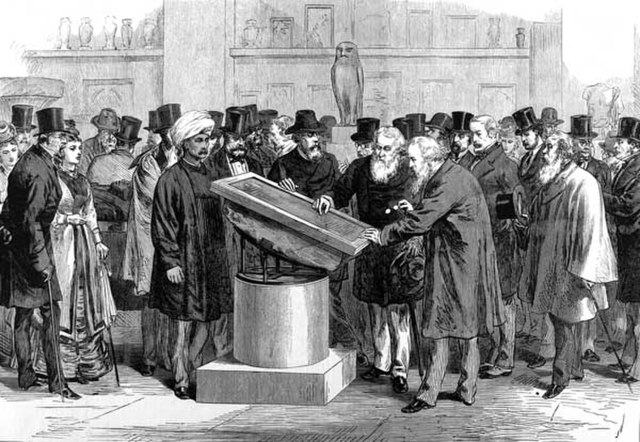
Orientalist scholars examining the Rosetta Stone at a Congress in 1874. Image: Wikimedia Commons
How the World Made the West
Josephine Quinn, Penguin Random House, 2024, hb., 572pps., $20
I first saw this book in the window of Blackwell’s bookshop in Oxford. I was struck – although not surprised – by how logically out of place it was, surrounded by the handsome architecture of old intellectual England. Written by Cambridge’s Chair of Ancient History, and issued by a major publishing house, it was yet another reminder of how once outré ideas have captured all the citadels.
Josephine Quinn is the daughter of a Labour politician noted for her interest in ‘gender’ equality, and she seems to have taken her mother’s life-lessons to heart by becoming Cambridge’s first female Chair of Ancient History. This is not to suggest her eminence is unmerited; 2018’s In Search of the Phoenicians was a clear-eyed analysis of the celebrated sailor-traders (she concluded they were never a monolithic group), and she has made other noteworthy contributions to our understandings of the ancient world. Nor is she consciously pursuing any agenda; indeed, most of what she writes is objectively true. Her book is nevertheless profoundly political, and one-sidedly unsettling.
The author’s aim is to call into question the conceptual connection between Greece and Rome, and a Western world she views as morally wanting. One might have assumed the notion of ‘Western civilization’ would be for a classical don author not just a given, but a given gratefully received. But no; she says,
“I want to tell a different story: one that doesn’t begin in the Greco-Roman Mediterranean and then re-emerge in Renaissance Italy, but traces the relationships that built what is now called the West from the Bronze Age to the Age of Exploration…I want to make the case that it is connections, not civilizations, that drive historical change.”
To the author, the very idea of there being discrete ‘civilizations’ is not just chimerical, but an anachronistic and damaging distortion. The ancients would never have seen the world in such a way, she maintains – and our seeing it so entails confrontation and conflict. Westerners have, she avers, for centuries used civilizational models to explain and justify exploitation, hierarchism, imperialism, injustice and racism. “It is time,” she concludes, “to find new ways to organize our common world.”
It is perhaps otiose to observe that the author does not explain what “new ways” she has in mind (if any). Could civilizational thinking be eradicated even if we wanted to? Human beings are sovereign individuals, of course; they are also members of groups by choice, who have always divided themselves into categories according to culture, geography, race or religion, with their own group coincidentally at the apex of achievement. Quinn herself notes the frequency of collectivism and exceptionalism from at least the first millennium BC up to today’s multiculturalism, which similarly assumes the existence of cohesive cultural entities.
As one would expect, the book is lucid, wide-ranging and usually interesting. Much of this history is already well-known, but it is useful to have it set out sequentially, and in such detail. Modern carbon and isotope analyses are providing ever more precise information about the odysseys of concepts, goods and people across the ancient world, and she brings us helpfully up to date.
Ideas about agriculture, architecture, art, food, language, learning, manufacturing, navigation, philosophy, religion and social organisation always spread outwards, albeit unevenly, from their originating areas. She reminds us, for example, of parallels between Babylonian and Hittite legends and the Homeric epics, although is careful not to exaggerate:
“…such borrowings contribute only a fraction of the content and meaning of these poems, which are in many ways dramatically different from the literature of Egypt and western Asia.”
There have always been such borrowings, echoes and parallels, as seen for example in the later interpenetration of Greek and Arabic learning, especially on astronomy, mathematics and medicine. Yet there were always important local variations, sometimes radical reactions against what were often seen as domineering and unsympathetic external forces – what we now term ‘glocalization.’
Cornish tin made it to Carthage, Welsh gold to Rome, gems from Afghanistan to Germany, Baltic amber to Anatolia, and Grecian pottery to India. Even animals and plants roamed far from home – the black rat and the domestic cat originated in Asia, camels and elephants were brought to the Balkans and Spain, and the vine arrived in Italy around the eighth century BC. Many people also covered epic distances, as government representatives, merchants, sailors or soldiers. The garrison shiveringly watching Hadrian’s Wall included legionaries from modern Romania and Syria. Tombstones from Roman London commemorate residents who started life in Antioch and Athens. A few Chinese merchants somehow materialised in Augustus’s Rome, even though, as the author is at pains to point out, the lionised ‘Eternal City’ was not necessarily the epicentre of the ancient world.
Military tactics travelled too, in more dramatic ways. Alexander was just the most celebrated of many ancient warriors – first expelling the Persians from Greece, then driving relentlessly east and south into India and Egypt, in quest of the “ends of the world and the Great Outer Sea,” before dying in Babylon, aged just 32. The glamorous Alexander, Quinn writes, “collapsed the distinction between Asia and Europe completely.” This is overstated, because Alexander was acutely conscious of his Macedonian identity, and on a mission to destroy the Persians (even though they had once been allies). His first action when he landed at Troy in 334 BC was to sacrifice to Athena and pour a libation to the Greek heroes. Although he achieved near-iconic status across the Near East, Asia and Europe were no closer after his death than before. Alexander’s exploits in fact fed growing Greek ethnic consciousness, and even now he is an icon of Hellenicity.
The Persians were probably the first civilizational collectivists – seeing themselves as a united cultural entity, ineffably superior to other peoples, with a ‘destiny’ to expand and impose their will. The Greeks responded enthusiastically, portraying the Persians as cruel, duplicitous, effete and tyrannical, and themselves as courageous, free and honourable, stalwart defenders of their shared homeland – stereotypes which, the author argues, still find echoes today. ‘Marathon’ and ‘Thermopylae’ still stir Western hearts, to the author’s chagrin. She is right that there is little logic in this link, but then logic amounts to little in human affairs – and what is so wrong anyway about being inspired by tales of heroism?
The chief problem with civilizational thinking, in the author’s eyes, is that it can justify racial prejudice. She hopes her examples of ancient mobility will allow Westerners to come to terms with today’s mass migration. She says feelingly, “People die at the hands of zealots for a White West,” and clearly people should not. Yet such crimes are mercifully rare in global and even national context, notwithstanding the lurid imaginations of thriller writers, or politically motivated government ‘reports.’ Far more people die daily at the hands of zealots for an expanded Ummah, or a Greater Russia.
She says that the Greeks would not have considered themselves ‘white.’ There is however evidence that both Greeks and Romans held fair coloration in high esteem – even though fair coloration was more associated with sun-starved northern ‘barbarians.’ Homer’s Hymns describe Demeter and Persephone as fair-haired. Heliodorus of Emesa’s novel Aethiopica (3rd or 4th century AD) centres around a blonde heroine born to the decidedly un-blonde Ethiopian queen (because conceived beneath a painting of pallid Andromeda). Attention-seeking Roman women wore light-coloured wigs, often made from the hair of slaughtered Gauls. A compendious 2004 work, The Invention of Racism in Classical Antiquity by Benjamin Isaacs, offers many other examples of prejudice against ‘barbarians’ of all complexions.
Western civilization, even as traditionally understood, has always been more absorbent than any other civilizational bloc. Indigenous European folkways and pantheism melded somehow with Middle Eastern monotheism, then almost equally exotic Greco-Roman culture. This uneasy ideational alliance was then overlaid by Reformed Christianity, and ultimately Enlightenment enquiry and individualism. There were always other influences too, whom at least some Westerners acknowledged, from Quinn’s own ‘Phoenicians’ to the Egyptians, and the Indians and Iranians embraced by 18th and 19th century Orientalists and philologists. Quinn mentions one British army officer who, in 1836, risked his life scaling a rock face in Iran solely to record a huge relief sculpture showing the Persian king Darius towering over enemy prisoners, with lengthy explanatory inscriptions he spent the next 11 years deciphering. No other civilization has been so interested in whatever was new and strange – or, more recently, so open to incomers that it is now risking its own stability. It incidentally seems unlikely that the Chinese, Islamic or Russian civilizations would allow their equivalents of Josephine Quinn to attain such prestigious positions.
This is an erudite work, by a well-intentioned writer. What a pity it is addressed to one civilization only – one, furthermore, that is already unravelling without the expert ‘assistance’ she here offers. For all her great intelligence, she cannot see that the freedom and tolerance that have allowed her (and us) to prosper will stand or fall with our myths. What might happen to the first global civilization to unliterally ‘disarm’? Perhaps we are already finding out.